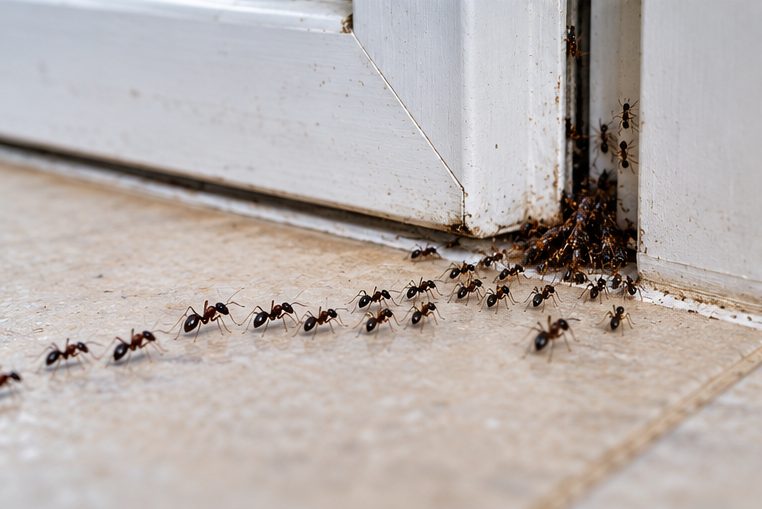
Trace it rather than wipe it away
The scent trail builds with every worker that makes the same round trip, so an ignored line tends to look busier over time rather than less, true near Stanmore too, where larger 1930s houses and gardens towards the edge of the borough near the Green. Wipe the trail away and the ants simply lay a new one, following it instead shows you where the colony actually is - the same pattern holds near Wealdstone, where denser flats and terraces near the High Street and the main line station.
The semi-detached gardens across the borough

Pinner, Rayners Lane and Harrow Weald all share the same basic pattern of a semi-detached house with a garden and patio behind it, and the warm, dry ground under paving slabs is exactly what an ant colony looks for. A nest doesn't have to sit right against the house - a low garden wall or path well away from the back door can still send a trail all the way indoors.
Stanmore's larger plots

Stanmore's bigger 1930s houses tend to have more established gardens, and a colony here can be settled under an older path or retaining wall some distance from the kitchen, which makes it worth tracking properly rather than assuming the nearest bit of paving is the source.
What to leave alone for now
- Spraying the trail, which kills the foragers you can see and leaves the colony intact
- Pouring boiling water into paving, which can damage mortar without reaching the queen
- Filling the entry gap before the nest is dealt with, which sends ants to a new gap instead
- Scattering powders along the trail, which can split a colony into several smaller ones
Closing the way in afterwards
After dealing with the colony, return to seal only the specific entry points the ants used, a doorway threshold, a pipe hole, or a crack in the mortar, as anyone near Harrow Weald will recognise, where semi-detached streets stretching out towards Bushey and the northern edge of the borough. Keep weep holes and air bricks open, blocking them as well only creates a damp problem inside the wall, true near Harrow Weald too, where semi-detached streets stretching out towards Bushey and the northern edge of the borough.
Booking ant control in Harrow
Ant control in Harrow runs £190 for a flat and £220 for a house, and because around Rayners Lane, where 1930s suburban semis built up around the tube station and shopping parade, it helps to say roughly whereabouts in the garden the nest might be when you book ant control, with the rest on the Harrow ant control page.