Seal after the colony is dealt with
Blocking the only route while a busy colony is still using it tends to push workers to the next weakness, which may be much harder to spot. Mark the entry points now with a piece of tape, and fill them once the activity has stopped.
Back doors and thresholds
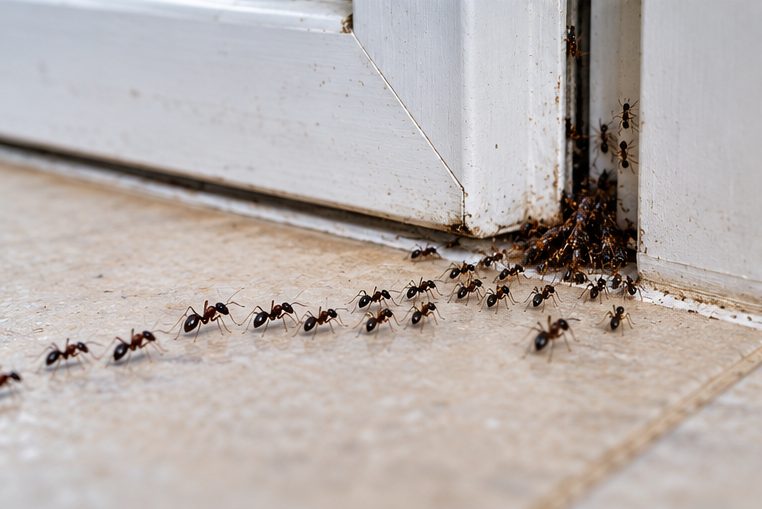
The gap under a back or patio door is the single most common way in. Check the threshold strip, the seal along the bottom of the door and the joint where the frame meets the floor. A brush or rubber door-bottom seal, plus a bead of exterior sealant along a cracked threshold, closes most of it. Sliding patio doors deserve a look too, as the bottom track often has drainage slots and open ends.
Around pipes and cables
Where a waste pipe, gas pipe, condensate pipe or cable passes through the wall, the hole is often cut wider than it needs to be. Inside, look behind the washing machine and under the sink; outside, check the same point on the wall. Small gaps take a suitable sealant or mortar. Rodents use many of the same openings, and rodent-proofing pipes and utility gaps covers bigger holes.
Cracks in mortar and render
Worn pointing near the ground and cracked render let ants into the wall and from there into rooms. Repointing a short stretch is a straightforward repair; long runs of eroded mortar are a job for a builder. Start at the height where you saw ants coming in, since a trail often relies on one particular crack.
Where an extension meets the house
The join between a newer extension and the original wall, and between the new floor slab and the old, is a frequent weak point. Slight settlement can open a hairline crack along it. Look for ants along that line inside and out, and seal it with a flexible exterior sealant. Recently renovated homes, like many in Queen’s Park, and extended houses with decking in Queensbury are worth checking here first.
Weep holes and air bricks: do not block them
Weep holes, the narrow vertical slots in the lowest course of brickwork or above windows, let moisture drain from a cavity wall, and air bricks ventilate floors and walls. Sealing either can cause damp. If ants are using them, purpose-made weep vent inserts, or fine mesh fixed behind an air brick grille, narrow the opening while keeping the airflow.
Inside the kitchen
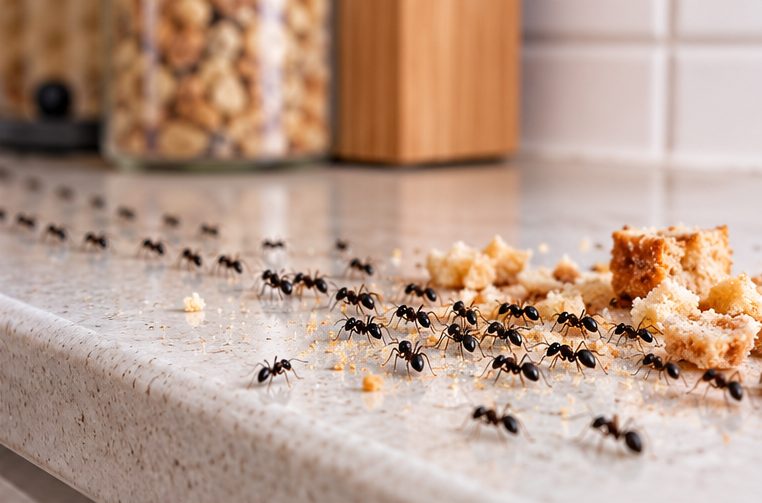
- Run sealant along gaps at the back of worktops and around the sink
- Fill gaps where skirting boards have shrunk away from the floor
- Close off holes around pipes inside base units
- Check window reveals where the frame meets the plaster
Windows and conservatories
Ants climb, so the joint where a ground-floor window frame sits on its sill, or where a conservatory base meets the house, can also be a route. Silicone around frames perishes over the years and is simple to renew.
Outside the back door

A colony in the paving right beside the door will keep testing for a way in. Standing pots and bins a little away from the wall, cutting back plants that touch the house and filling open joints in the slabs nearest the building all make it harder. The usual nest sites are described in where ants nest around houses.
Proofing and treatment together
Sealing on its own rarely stops an established colony living next to the house, and treatment holds up better when the gaps are closed afterwards. Book ant control to deal with the colony, then seal. Ant control in Brent is £190 for a flat and £220 for a house, and what to expect after the visit is in how long professional ant treatment takes.