What a colony looks for
A black garden ant queen digs her first chamber alone after her mating flight. Soil that drains well and warms in the sun suits her, and anything lying on top, whether a slab, a stone or a board, holds that heat and keeps the brood dry. Over a few years the tunnels can spread through a surprising area of ground, and a mature colony can hold thousands of workers fed by what the foragers carry home.
Under patios and paving slabs
This is the most common site of all. Slabs bedded on sand give easy digging and a warm roof. Fine sand pushed up through the joints is the giveaway, and weeds or missing pointing between slabs only make it easier for the colony.
Paths and the edge of the drive
Block paving, crazy paving and cracked concrete offer similar conditions. Colonies often follow the edge where a path meets a lawn or border, where the soil is both loose and sheltered. Kerb edging and the gap under a garden step are popular too.
Front gardens and bin stores
Front paths, bin stores and the ground around recycling boxes get less attention than the back garden, but they can host colonies as well, particularly where spilled drinks and food residue collect. Rinsing bins and keeping lids shut removes one reason for workers to linger by the front door.
At the base of the house wall
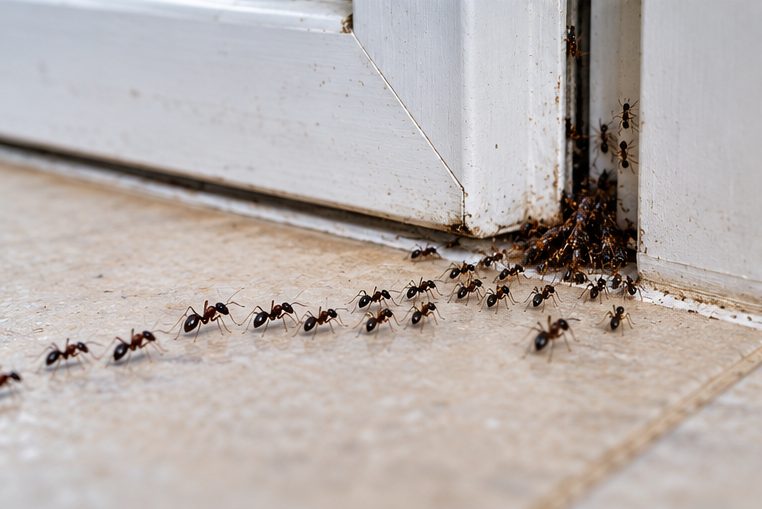
The strip of soil along the foot of a wall is dry, protected and warmed by the building. Nests there sit right beside air bricks, door thresholds and gaps in the brickwork, which is why the kitchen trail can be so short. Older terraces with worn pointing at ground level, like many around Kensal Green, give workers plenty of cracks to use.
Lawns, borders and plant pots

In a lawn, a nest shows as small mounds of fine soil, especially along a sunny edge. In borders, ants live among roots and often tend aphids on the stems for their sugary honeydew. Big pots and planters on a patio are warm and rarely moved, and a colony can take over the whole root ball.
Under decking and around extensions
Decking over soil or gravel gives a dry, shaded void with gaps to come and go. Where a rear extension was built out into the garden, the join between the new floor slab and the original house can open a little, leaving a crack straight inside. Houses in Queensbury with raised decks beside kitchen extensions are a good example. Larger, flying insects using a hole under decking are more likely wasps — see wasp nests in the ground.
Compost bins, sheds and log piles
Compost heaps hold warmth, and the ground under a shed base, a timber stack or an old slab propped against a fence gives cover. Nests at the far end of the garden are less likely to be feeding a kitchen trail, though it is not impossible. Pots stored upside down against a wall are another favourite.
Inside the building

Now and again a colony moves into the house itself: under a solid floor, beneath suspended timbers, in a wall void or next to hot water pipes that keep the area warm. Ants appearing through floorboards or skirting in the cold months point this way. In a flat, the source may instead be a shared courtyard or garden below. More detail is in can ants nest inside walls.
Narrowing it down
Rather than lifting slabs all over the garden, follow the workers from the place they come in; how to find an ant nest explains how. Then book ant control and mention the spot you found. Ant control in Brent is £190 for a flat and £220 for a house.