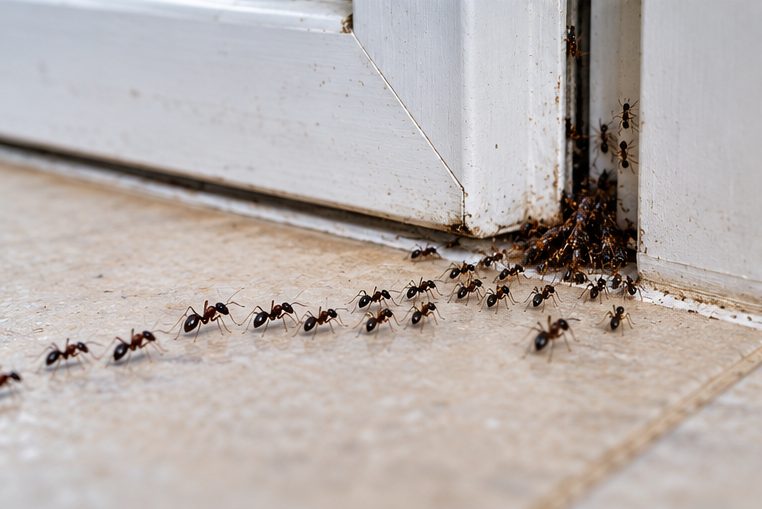
Trace the line, don't just clean it up
Each worker ant that repeats the same route to food and back strengthens the scent trail for the next one, which is why a line seems to grow busier the longer it runs. Watching where it goes, rather than wiping it away, is what actually leads to the nest.
Find where they enter the room
Pick a warm, still part of the day, when activity peaks, and follow the line back to its point of entry rather than interrupting it. A gap at a patio door threshold, pipework entering the kitchen, or a worn window frame are the usual candidates - mark whichever one it is.
Gardens along the broad avenues

Ealing's Victorian and Edwardian avenues typically come with larger gardens, and a patio laid against the house gives a colony the warm, dry conditions it favours. The nest itself does not have to be close to the building - paving joints or a low garden wall well away from the kitchen can still send a trail indoors.
Smaller gardens in Southall and Acton

Where gardens are more modest, in the denser streets of Southall and Acton, a nest is more often found tight against the back wall of the house itself or under a short run of paving near the door - a shorter trail to trace, but no less determined once established.
What to leave alone for now
- Spraying the trail, which kills the foragers and leaves the colony intact
- Pouring boiling water into paving, which can damage mortar and rarely reaches the queen
- Filling the entry gap before the nest is dealt with, which sends the ants to a new gap
- Scattering powders along the trail, which can split a colony into several smaller ones
Closing the way in afterwards
Once the colony has been cleared, go back and seal just the gaps the ants were actually using, whether that's a threshold, a pipe hole or a crack in the mortar, as anyone near Greenford will recognise, where interwar suburban streets and newer housing close to the Grand Union Canal. Don't seal weep holes or air bricks, doing so just locks damp inside the wall structure - the same pattern holds near Southall, where densely terraced streets and multi-let houses.
Booking ant control in Ealing
Ant control in Ealing runs £190 for a flat and £220 for a house, and because around Northolt, where interwar semi-detached suburbia towards the borough's western edge, it helps to say roughly whereabouts in the garden the nest might be when you book ant control, with the rest on the Ealing ant control page.